
Memory Lane
Figma
February - May 2025 (4 months)
User Persona
User Requirements
Context Scenario
Storyboard - Product design solutions
Visual Identity & Branding
Mid-fidelity Wireframes
High-fidelity interactive prototype
Final Report
Individual Project
Role
Product Designer
Deliverables
Project type
Duration
Tools
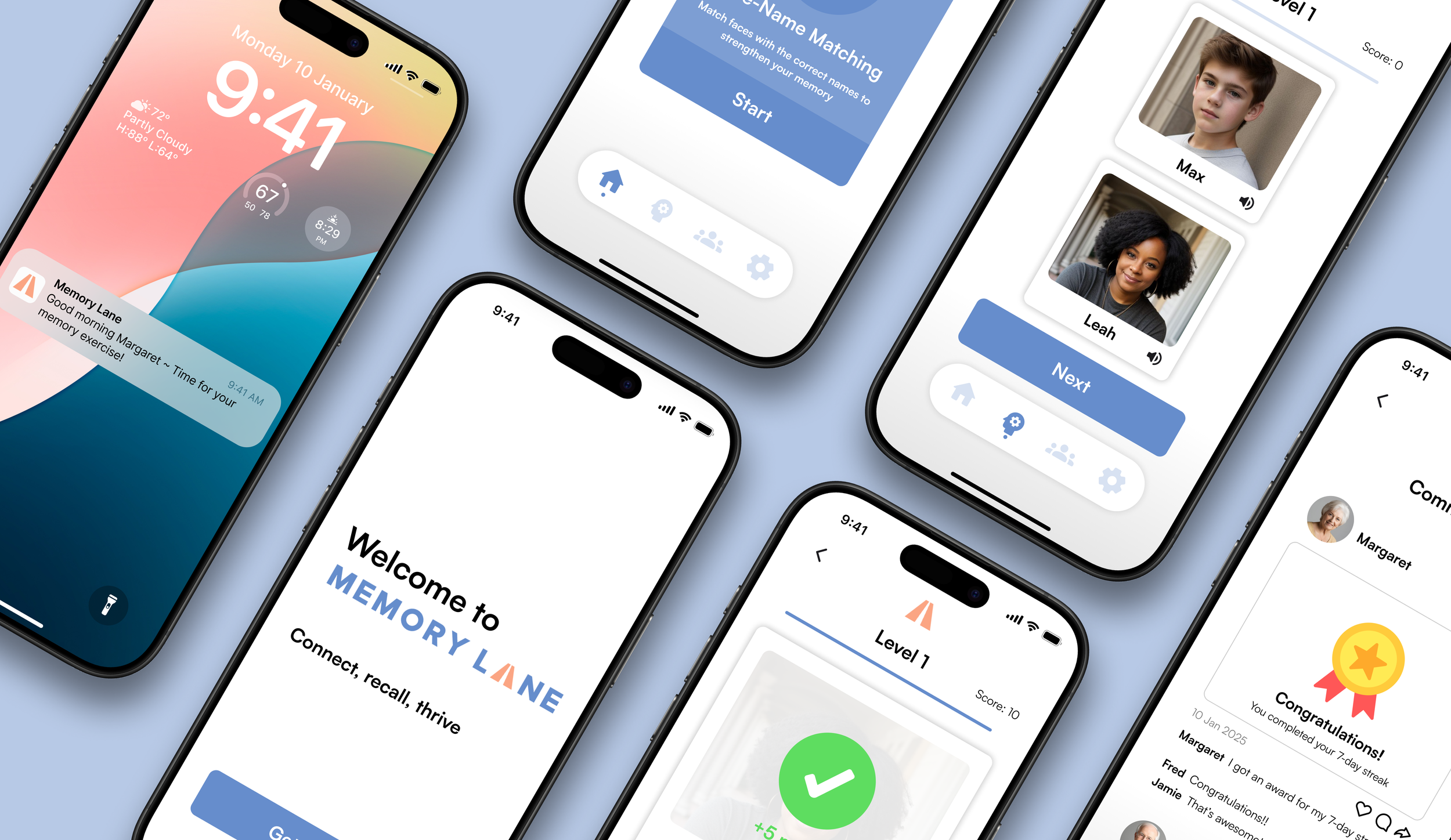
A mobile application prototype of an episodic memory training technology-enhanced learning environment
2025
OVERVIEW
Introduction
Memory Lane is a mobile application prototype designed to help older adults train and improve their episodic memory through gamified daily exercises.
This project addresses a critical gap in existing memory training applications, which predominantly focus on working memory despite episodic memory showing the greatest age-related decline and directly impacting quality of life. Through implementing optimal notifications, gamification for motivation, and community features for social learning, Memory Lane transforms episodic memory training from a clinical task into an accessible and engaging experience.
The application aligns with how older adults use technology in daily life, making cognitive maintenance convenient and less stigmatizing than traditional memory clinic attendance.
The Process
RESEARCH
Episodic Memory
Episodic memory enables individuals to recall personal events with "what," "where," and "when" details, and displays the largest degree of age-related decline, typically beginning between ages 65-70. This decline significantly impacts quality of life and can serve as an early indicator of cognitive impairment, as brain changes associated with Alzheimer's disease may begin up to 20 years before symptoms appear.
Despite its importance, most existing memory training applications focus predominantly on working memory, representing a significant gap in digital interventions.
Game-based approaches with gamification elements such as rewards, challenges, and social interactions show promise for enhancing both outcomes and user engagement in memory training. Research indicates that older adults (60-75 years) perform significantly better on verbal and memory tasks in the morning, suggesting that timing interventions during peak cognitive performance periods could enhance their effectiveness.

DESIGN
Motivation
The initial concept broadly focused on memory recall without a specific target audience, which made establishing appropriate design choices difficult. Through consultation and research, the focus was refined to episodic memory training after discovering that it experiences the greatest age-related decline and is not adequately addressed by existing learning environments.
User Persona
A user persona was created to establish the target audience of older adults aged 60 years or more, which guided the development of a technology-enhanced learning environment through a game-based mobile application prototype specifically designed for episodic memory training.
User Requirements
User requirements were identified through context scenario development and research into older adults' needs, revealing that seniors required accessible technology with clear instructions, convenient integration into daily routines, and less stigmatizing alternatives to memory clinics.
The requirements emphasized multimodal sensory approaches combining visual and audio elements, adaptive difficulty to maintain engagement without frustration, gamification through reward systems, and community features to reduce isolation and foster social learning. These requirements were translated into design solutions demonstrated through storyboards showing the interaction between users and the face-name matching learning activity.
Visual Identity & Branding
The visual identity was designed with a color palette balancing warm and cool tones to promote calmness and focus, while supporting visual accessibility for older adults through contrasting colors that avoid visual fatigue.
The application name "Memory Lane" was intentionally selected using familiar words that resonate with the target audience and align with the memory training purpose.
The typography features a simple, bold, capitalized sans-serif font for easy readability, ensuring the interface remains clear and accessible for older users with varying levels of visual acuity.
Storyboard
The storyboard illustrates Margaret Wilson's (user persona) typical interaction with Memory Lane. Her day starts with receiving an optimal morning notification and proceeding through the face-name matching exercise. The visual narrative demonstrates key interactions including studying faces with audio pronunciation support, using drag-and-drop functionality to match names, receiving encouraging feedback for incorrect answers, and sharing achievements through the community feature.
This storyboard served as the foundation for translating user requirements into concrete design solutions that show the step-by-step learning activity flow.
Mid-Fidelity Wireframes
Mid-fidelity wireframes were created to visualize the overall user flow, component layout, and design choices for each screen of the application.
Based on feedback received, key improvements were implemented including replacing text input with drag-and-drop functionality for easier interaction and changing negative feedback (big 'X') to encouraging messages like "Almost there... Try again" to better support older adult users.
RESULTS
Interactive Prototype
The final interactive prototype demonstrates the complete user journey.
It starts with the user receiving an optimal morning notification, and then the user would log in to the personalized home screen with a face-name matching exercise.
During the exercise, users can tap to zoom into images, listen to name pronunciations via audio icons, and use drag-and-drop interaction to match names with faces, receiving immediate visual feedback through color-coded outlines (green for correct, red for incorrect) and encouraging messages.
A progress bar indicates position within each level, while adaptive difficulty automatically increases based on user performance to maintain appropriate challenge without overwhelming users.
Upon completion, users receive achievement badges for milestones like 7-day streaks and can share their progress through the community feature, where they can post, like, comment, and learn from other users' experiences.
REFLECTION
From Theory to Design
Memory Lane's design was influenced by multiple learning and motivational theories working in combination to address the specific needs of older adults.
Behaviourism guided the reward system and positive reinforcement, while Connectivism informed the community feature for social learning and shared experiences.
Self-Determination Theory supported user autonomy through personalized settings, competence through adaptive difficulty, and relatedness through social connections, while Malone and Lepper's intrinsic motivation model shaped the inclusion of progressive challenges, curiosity-stimulating elements, and competitive-cooperative community features.
The multimodal approach combining visual and auditory stimuli aligns with Cognitive Load Theory to optimize information presentation, though future improvements could incorporate Constructivist principles by allowing users to generate personally meaningful content to strengthen episodic memory training.
Innovative Interactions
The innovation in Memory Lane lies within the application itself rather than the hardware:
Featuring a notification system that delivers reminders at optimal times based on research showing older adults perform significantly better in the morning.
The face-name matching exercise employs multimodal learning through combined visual and auditory stimuli, creating richer memory traces that closely resemble real-world memory challenges applicable to daily life, enhanced by adaptive difficulty that prevents both frustration and boredom.
The integration of community features allows users to share achievements and engage in communal learning, eliminating barriers associated with traditional memory training by providing seamless integration into daily routines without requiring special equipment or clinic appointments.
Memory Lane improves upon existing applications by specifically targeting episodic memory rather than working memory, incorporating real-world application over abstract exercises, and leveraging motivational theories to maintain long-term engagement.